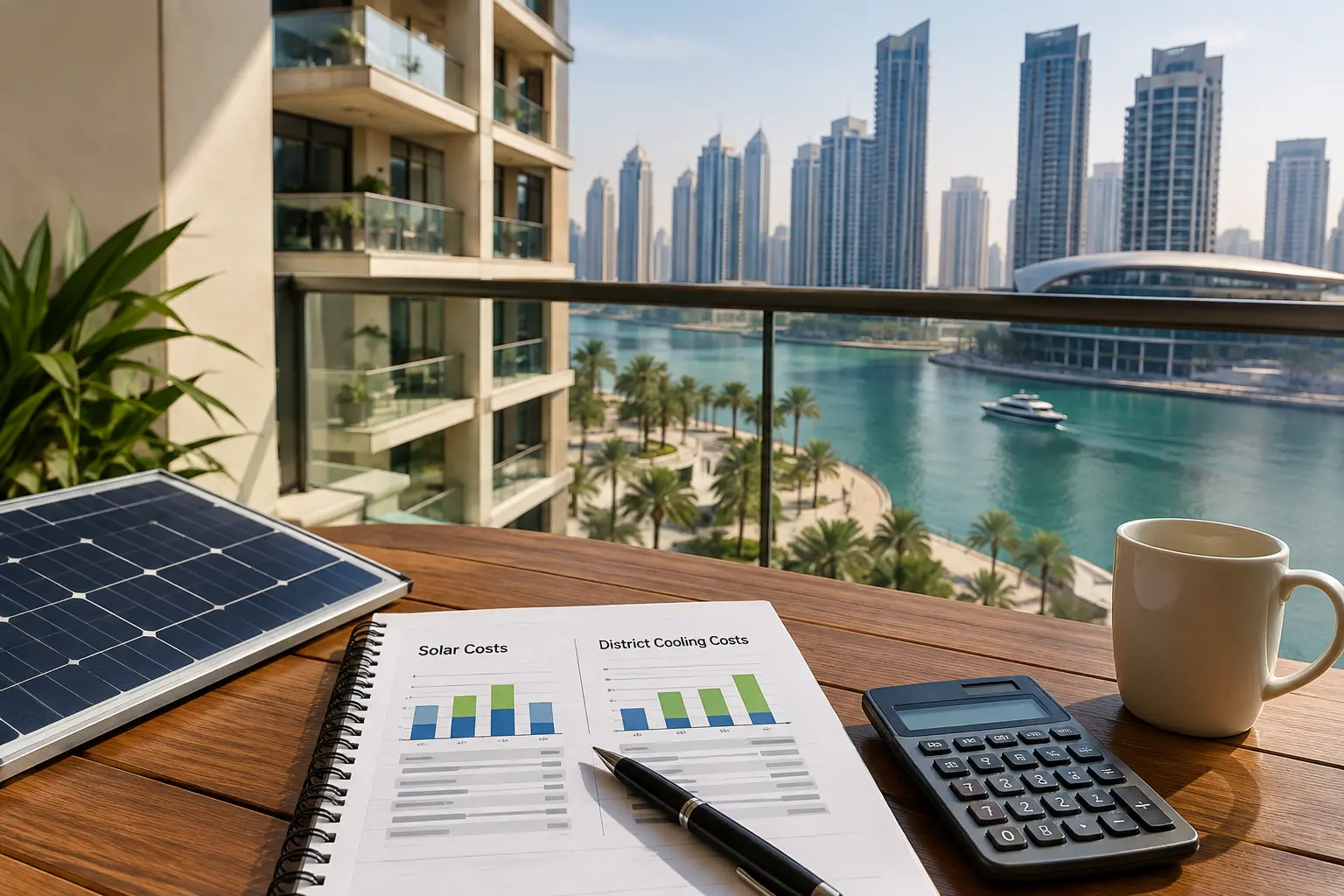
How to Compare Solar and District Cooling Costs in Dubai Apartments
Cooling is one of the most important household expenses in Dubai, especially during the long summer season. When comparing apartments, buyers and tenants may ask whether solar energy can reduce cooling costs or whether a building connected to district cooling offers better value. The answer depends on the apartment’s design, utility arrangements, cooling provider, service charges, ownership rules and expected usage.
Learning how to compare solar and district cooling costs in Dubai apartments requires more than comparing two monthly bills. You need to separate electricity consumption from cooling charges, identify one-time costs, estimate realistic savings and consider whether residents can install or benefit from solar equipment in the first place.
Understand what each system pays for
Solar panels generate electricity from sunlight. In a villa or a building designed with shared renewable-energy infrastructure, solar power may offset electricity imported from the grid. However, an individual apartment owner usually cannot install panels on a private balcony or roof without building approval, technical assessment and compliance with applicable regulations. In many towers, the roof and external façades are common areas managed by the owners’ association or building operator.
District cooling works differently. A central plant produces chilled water and distributes it to connected buildings. The apartment uses a fan-coil system to circulate cool air indoors. Residents may be charged a variable consumption fee, a capacity or demand fee, metering charges and VAT, depending on the provider and building arrangement. Some developments bill district cooling separately, while others include related charges in a consolidated utility statement.
Dubai’s district cooling framework regulates providers and billing services, while approved tariff structures can include consumption charges measured in refrigeration tonne-hours and, in some systems, capacity charges. This means a low-occupancy apartment can still have a fixed cooling cost even when its variable usage is limited.
Start with the building’s actual billing structure
Before making a cost comparison, request recent utility statements from the landlord, seller or property manager. Ask for at least one summer bill and one cooler-season bill. Check whether the following items appear separately:
- DEWA electricity consumption
- District cooling consumption
- Cooling capacity or demand charges
- Metering or administrative fees
- Fuel surcharge
- VAT
- Building service charges related to shared energy systems
DEWA residential electricity uses progressive consumption slabs. The published tariff schedule lists rates of 0.230 AED per kWh for the first 2,000 kWh, 0.280 AED for the next band up to 4,000 kWh, 0.320 AED up to 6,000 kWh and 0.380 AED above that, before applicable surcharges and taxes. Actual bills can therefore rise faster when air-conditioning, appliances and other loads push consumption into higher bands.
Do not assume that the entire electricity bill represents cooling. Lighting, appliances, water heating, cooking equipment and home-office devices also contribute. A useful comparison isolates the cooling-related portion wherever the bill or building statement provides enough detail.
Calculate the full cost of solar
Solar should be evaluated using total ownership cost rather than panel price alone. Your estimate may include:
- Equipment purchase or subscription costs
- Design and installation
- Structural and electrical approvals
- Inverter replacement or repairs
- Cleaning and maintenance
- Insurance or monitoring fees
- Battery storage, if required
- Shared-building contributions
For an apartment, the first question is feasibility. If the building cannot allocate roof capacity to your unit, private solar may not be a practical option. A community solar programme or a building-wide installation could still reduce shared electricity costs, but the financial benefit would depend on how savings are distributed among owners and whether the system powers common areas or individual apartments.
Estimate annual solar savings by multiplying expected generation by the electricity cost avoided. Then subtract maintenance, financing and replacement costs. A simple payback calculation is:
Payback period = total solar investment ÷ annual electricity savings
This calculation is only a starting point. Solar output varies with system size, shading, orientation, dust and equipment performance. A system that offsets general electricity consumption may not directly reduce a separate district cooling invoice.
Calculate the full cost of district cooling
District cooling can offer efficient centralised cooling, but the bill must be reviewed carefully. Add together all fixed and variable charges over a full year. Use actual consumption data where possible rather than relying on a marketing estimate.
For each month, record:
- Fixed capacity or connection charge
- Cooling consumption in refrigeration tonne-hours
- Consumption tariff
- Metering and service fees
- Fuel surcharge
- VAT
District cooling tariffs may differ between systems, so compare the tariff schedule for the exact building. A regulatory tariff document shows that approved consumption charges can vary by system and that some single-building systems may not allow capacity charges for individual units. The practical lesson is to confirm the terms for the specific apartment rather than using a citywide average.
Also examine whether cooling is included in the annual service charge. A building with a higher service charge may cover certain central systems, while a lower service charge may be paired with separate resident billing. Comparing only the monthly utility statement can produce an incomplete result.
Use a like-for-like annual comparison
Create two annual scenarios: the current district cooling arrangement and the solar-supported alternative. Include 12 months of expected bills, not only peak summer months. Your worksheet should include electricity, cooling, service charges, maintenance, financing and one-time costs.
For example, if solar reduces grid electricity but leaves district cooling unchanged, count only the electricity savings. If a building-wide solar project also powers cooling equipment, obtain written details explaining how the reduction reaches individual owners. If cooling charges are fixed or capacity-based, lower electricity use may not produce an equal reduction in the cooling bill.
Compare the results using three measures:
- Monthly cash flow: what you pay during a typical month
- Annual operating cost: what you pay over a full year
- Total cost of ownership: operating costs plus installation, financing and replacements
Run a conservative case with lower solar generation, higher maintenance and rising utility consumption. This helps prevent overestimating savings.
Compare apartments, not just energy systems
Energy costs are one part of a property decision. A more efficient apartment may have a higher purchase price, service charge or mortgage payment. A less expensive apartment may have higher cooling costs but a lower overall monthly housing cost.
Use Mena Homes’ area comparison tool to review locations and property characteristics side by side. Consider building age, insulation, window exposure, floor level, orientation, occupancy, parking and access to transport. These factors can affect both comfort and utility consumption.
For buyers, review the building’s service-charge history, reserve fund, cooling contract and maintenance records. Ask whether the apartment has an individual cooling meter, whether the system is owner- or tenant-paid and whether any unpaid cooling balance transfers with the property.
Include financing in the affordability test
Solar improvements or a more energy-efficient apartment may appear affordable when viewed only through expected utility savings. However, the purchase price and loan repayment usually have a much larger effect on household cash flow. Estimate the down payment, interest rate, loan term, monthly instalment, service charges, utilities and insurance together.
Mena Homes provides information for buyers exploring mortgage options in the UAE. Use realistic income and expense figures, and allow room for variable electricity and cooling bills. Banks may assess income, existing commitments, residency status, loan term and the property’s value when determining eligibility.
A sensible housing budget should remain manageable even during high-consumption summer months. If solar savings are uncertain or dependent on building approval, do not treat them as guaranteed income when deciding how much to borrow.
Questions to ask before choosing an apartment
- Who supplies and bills the district cooling service?
- Are there fixed capacity, connection or metering charges?
- Is cooling included in the service charge?
- Can residents participate in a shared solar installation?
- Who owns and maintains the roof-mounted equipment?
- What approvals are required for solar modifications?
- Can the seller provide summer utility statements?
- Are there outstanding utility or cooling balances?
- How might the costs change if occupancy increases?
Final takeaway
The best comparison is based on the apartment’s real billing structure, not on the advertised efficiency of solar or district cooling in isolation. Solar can reduce electricity purchased from the grid when installation is feasible, while district cooling may provide centralised comfort with fixed and variable charges. Review a full year of bills, include service charges and maintenance, and test the result against your mortgage budget before making an offer.
Estimate your home loan with our Mortgage / Affordability Calculator