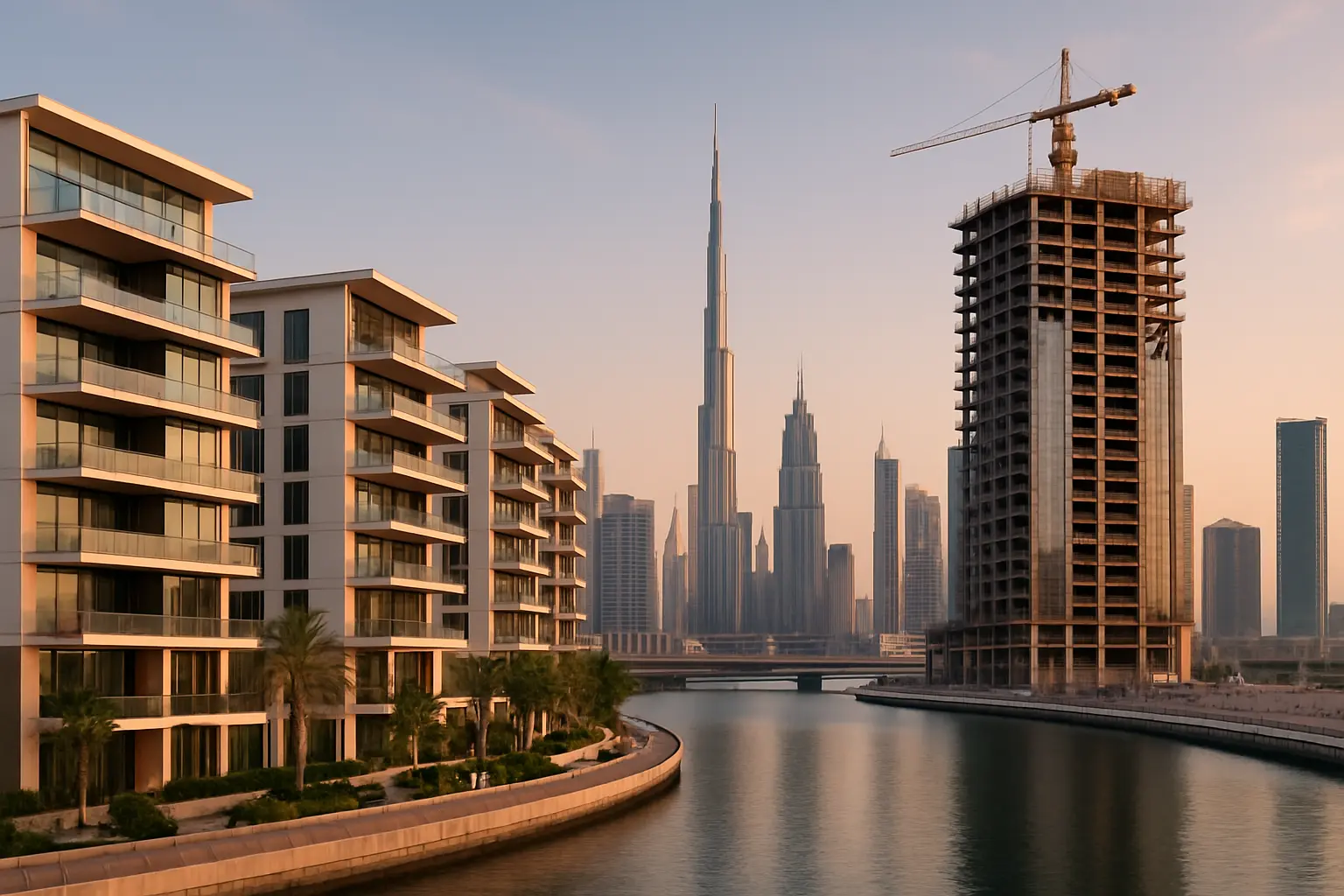
The performance of the property market in the United Arab Emirates continues to provide a fascinating study for global property investors, funds, and macroeconomic analysts. When studying the latest performance metrics, it becomes immediately apparent that the regional marketplace is undergoing a highly fascinating phase of development characterized by deep volume pools and selective capital migration. According to the residential sales register data collected from land departments, the velocity of capital movement remains highly robust even as certain segments experience a natural normalization process after several consecutive years of explosive price expansion across both major emirates.
Understanding the detailed mechanics behind this transition requires an objective look at transaction volumes, underlying capital distribution patterns, and macroeconomic demand triggers. Total market liquidity remains exceptionally strong across both established and emerging corridors, showing that institutional investors are continuously rotating capital into specific sub-asset classes depending on yield profiles, developer delivery tracks, and localized micro-market fundamental variables. This extensive, data-driven assessment unpacks the complete institutional architecture of the local property sector as of April 2026.
Current Market Snapshot and High-Level Transaction Dynamics
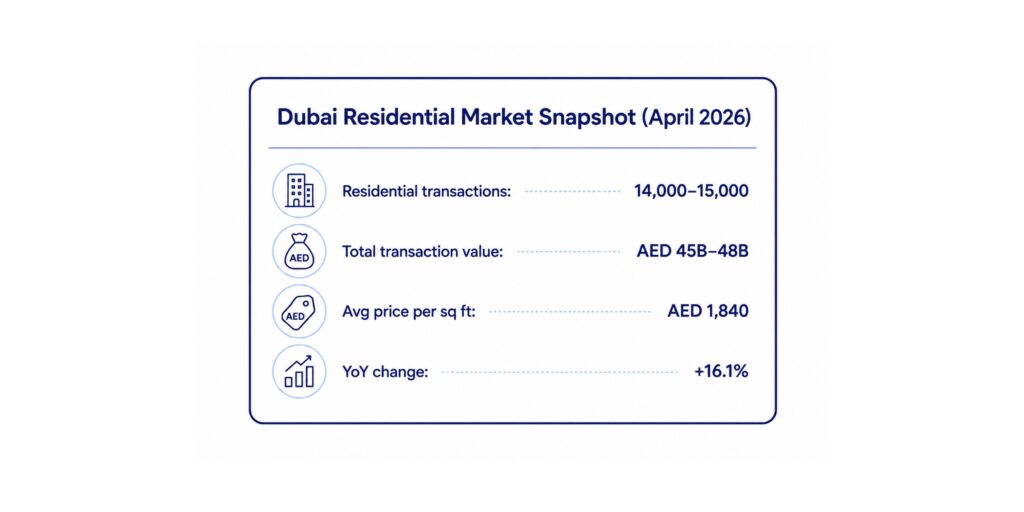
The overall transaction velocity within the emirate during the month of April 2026 highlighted an exceptional surge in investment commitment across multiple asset classes. A comprehensive review of the current market snapshot reveals that the city registered approximately 14,000 to 15,000 residential transactions across various project types, structural layouts, and construction phases. This collective activity generated a total transaction volume that reached an impressive valuation of approximately AED 45 billion to AED 48 billion in aggregate terms, proving that absolute transactional depth remains intact despite minor seasonal variations and regional geopolitical conversations.
When examining the underlying factors driving this significant capital deployment, global macro players note that ongoing baseline population growth and an influx of international high-net-worth individuals continue to form the baseline support for localized demand metrics. This steady arrival of new residents looking to establish an immediate local footprint means that individuals can effortlessly browse residential properties for rent in Dubai to find immediate premium accommodations. This population expansion momentum has allowed corporate real estate networks to deploy capital efficiently into the residential marketplace.
A specific standout figure from the latest data is the pricing metric, which shows that the average price per square foot has hit an absolute record price per square foot level of AED 1,840, representing an impressive 16.1% year-on-year increase across the aggregated metropolitan area. This peak pricing baseline illustrates that despite fears of near-term oversupply, organic user demand continues to outpace historical projections. The underlying market depth is heavily characterized by a robust off-plan demand cycle that shows no immediate signs of a major structural reversal, as international purchasers continue to favor early-stage allocations over ready options in specific hyper-growth communities.
Ready vs Off-Plan Structural Dynamics Across the Local Sector
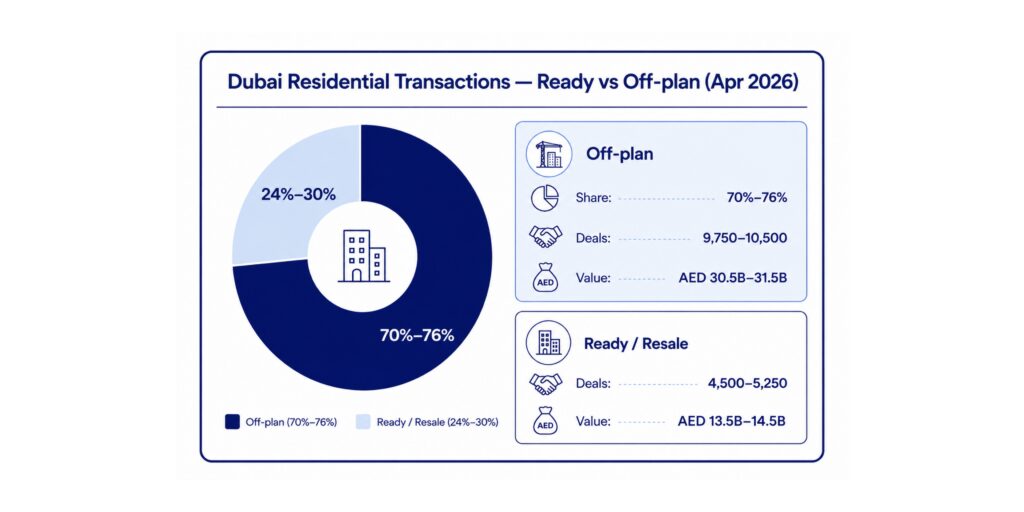
The core structural landscape of the metropolitan property marketplace is heavily defined by the interaction between secondary market listings and newly launched development schemes. In April 2026, the off-plan apartment segment along with corresponding villa developments secured an overwhelming majority of localized transaction activity, commanding a dominant share that hovered between 70% and 76% of all recorded residential business. Specifically, off-plan transactions accounted for roughly 9,750 to 10,500 deals, translating directly into a massive financial commitment of approximately AED 30.5 billion to AED 31.5 billion.
This extreme concentration of capital demonstrates that forward-looking real estate decision-makers remain highly confident in the long-term economic narrative of the city and its infrastructure expansions. The competitive payment terms, long-term payment schedules, and localized capital appreciation prospects during the construction process continue to act as key investment drivers for foreign investment entities. For those who are looking to secure immediate capital appreciation advantages or lock in permanent vacation spaces, it is highly recommended to explore residential properties for sale in Dubai before construction milestones cause pricing steps to adjust upward.
On the alternative side of the structural divide, completed resale options contributed approximately 4,500 to 5,250 registered transactions, which brought in a total transaction value of AED 13.5 billion to AED 14.5 billion. This secondary volume demonstrates a steady baseline level of end-user activity, primarily backed by incoming families looking to establish immediate residency within prime established master-planned districts. These purchasers prioritize immediate occupancy and physical asset verification over future delivery promises, which keeps secondary market transaction velocity well above historical averages. While some areas show localized price adjustments due to rising completed ready resale inventory, premium neighborhoods are maintaining strong pricing power due to limited near-term availability.
Geographical Comparisons: Analyzing Capital Shifts to Abu Dhabi
An evaluation of the regional real estate environment is incomplete without checking the ongoing transactional expansion in neighboring capital zones. The Abu Dhabi residential market has displayed its own accelerating transaction liquidity index, logging approximately 1,450 transactions in April 2026 that generated a solid financial volume of AED 5.8 billion. Much like the trends visible in the neighboring metropolitan areas, the forward development space spearheaded the bulk of this activity, capturing an impressive 68% of total transaction volumes and a substantial 82% of the aggregate transaction value.
This capital movement represents an important structural market shift as international investment desks look to maximize asset class diversification by building exposure in the capital city. Foreign direct buyers comprised roughly 55% of the transactional activity in the capital during April 2026, targeting newly released high-end beachfront apartments and low-density villa communities situated across Yas Island and Saadiyat Island. This specific institutional market watch reveals that prime ready apartments located in locations such as Al Reem Island are seeing steady secondary transactional velocity, which helps keep localized rental yield structures stable.
Pricing Realities, Cap Rates, and Rental Yield Performance
An objective look at the current pricing architecture reveals a stabilizing marketplace where the intense growth trajectory of recent years is transitioning into a mature, sustainable trend line. Within the core apartment category, baseline market pricing settled near an average of AED 1,350 per square foot, providing an attractive point of entry for income-focused institutional core strategies. The broader metropolitan area is currently demonstrating a global gross yield performance averaging 5.2% across all combined categories, though significant variations emerge when looking closer at individual property classifications and target market spaces.
Affordable apartments are currently leading the market in terms of income generation, providing excellent high rental yields that frequently hit 6.8% to 7.1% in denser suburban clusters. These excellent entry-level performance numbers are driven by solid rental tenant fundamentals and a lower absolute cost of entry per unit, making them prime targets for yield maximization. Mid-market apartments are maintaining a stable typical gross yield of 5.2%, backed by consistent occupation numbers from incoming professional expats.
In contrast, prime apartments and luxury waterfront villas are trading at compressed cap rates ranging from 3.2% to 3.6% in aggregate. This compression indicates a premium supply scarcity across high-end luxury settings, where wealthy buyers prioritize regional capital preservation and lifestyle attributes over near-term income optimization. Financial advisors are recommending that institutional investors overweight affordable and mid-market apartments while taking a neutral position on high-end suburban properties, where future capital expansion metrics could face pressure due to rising local supply pipelines.
Detailed Micro-Market Project Analysis and Corridor Allocation Guide
A deep dive into specific micro-markets shows that Jumeirah Village Circle has maintained its undisputed position as the highest-volume affordable zone within the local ecosystem, accounting for a notable 28% total market share within its designated property classification. The neighborhood recorded a substantial 1,250 total transactions during April 2026, heavily supported by first-time real estate investors targeting properties priced under AED 1.5 million. Within this highly liquid community, one-bedroom properties command a median price of AED 1.1 million at AED 1,450 per square foot, while two-bedroom properties require a median outlay of AED 1.7 million at AED 1,380 per square foot.
Specific residential projects like JVC District 10 recorded 180 off-plan sales at an average of AED 1,420 per square foot, while the completed Azizi Views project served as a major transaction anchor with 140 deals closing at AED 1,390 per square foot. Simultaneously, Wadi Al Safa 3 has emerged as a compelling value play for strategic long-term portfolio planning, capturing a 12% segment market share through 450 registered real estate transactions. The community presents an entry-level framework where one-bedroom units average a median ticket size of AED 950,000 at AED 1,250 per square foot, drawing considerable attention from budget-conscious end-users.
Projects like Safwa Residence registered 110 transactions at AED 1,230 per square foot, benefiting from upcoming infrastructure catalysts and nearby service connections. Outside of these residential alternatives, corporate entities looking to minimize operational overhead while expanding regional visibility can also review choices to find commercial properties for rent in Dubai to capture competitive lease structures. Furthermore, institutional groups looking to add permanent commercial structures or permanent office space to their holdings can easily acquire commercial properties for sale in Dubai to ensure long-term stability.
Risk Scorecard: Evaluating Future Pipeline Pressures and Mitigants
While the overall transaction data shows solid demand, an expert institutional market watch must evaluate the clear challenges and potential headwinds facing the property market over the next twelve months. Analysts emphasize that the local cycle is moving into a late-expansion phase, where overall capital price expansion is expected to moderate compared to the double-digit annual gains seen in previous years. The most significant area on the risk heatmap is the supply and pipeline dimension, which currently shows elevated indicators across several mid-market segments.
With massive development completions moving forward, tracking actual developer pipeline clarity and monitoring real-time handover momentum tracking are becoming increasingly important metrics for risk managers to monitor. Over 150,000 new units launched throughout 2025 are projected to add considerable ready resale inventory over the next twenty-four months, which could create a temporary supply overhang in high-density suburban communities. This upcoming wave of completions will test absorption rates and may place temporary downward pressure on rental pricing across secondary apartment sectors.
Additionally, stricter loan-to-value limits and prolonged global interest rate environments are creating a selective buying phase, as highly leveraged domestic purchasers find their borrowing capacity reduced. Fortunately, these financing constraints are helping to protect the ecosystem from wider systemic risks by preventing excessive speculation. To counter these elements, many foreign funds choose to diversify, allowing them to safely invest in residential real estate in Dubai through cash-backed portfolios that protect against interest fluctuations. The current market is heavily driven by cash purchases and well-capitalized international equity, providing a solid foundation of stability that sets this current cycle apart from historical peaks.
Strategic Conclusions and Institutional Portfolio Guidance
The evolving real estate environment across the region requires a disciplined, highly selective approach to future investor capital allocation. The era of generalized market buying where all asset classes rose together has passed, giving way to a mature phase that rewards deep micro-market research and exact project selection. Institutional portfolio managers are adjusting their asset weightings to align with these changing market realities, maintaining an overweight stance on premium villas and townhouses where low-density layouts and structural scarcity provide localized pricing resilience.
In contrast, analysts advise a neutral or cautious approach toward high-density apartment blocks in secondary locations where upcoming primary launch activity and future supply pipelines are most concentrated. In the off-plan arena, the most successful strategy involves focusing on trusted, top-tier developers with established track records of timely project execution and superior infrastructure delivery. Diversifying real estate holdings across both Abu Dhabi waterfront expansions and secondary land market zones allows investors to enjoy a balanced mix of steady rental yields and capital preservation.
By maintaining a balanced portfolio split-allocating roughly 70% to liquid off-plan projects in core infrastructure corridors and keeping a selective approach to secondary market assets-investors can successfully navigate future supply additions while capitalizing on the region's positive population and economic trends.